

Introduction
You built a great website. You post on social media. You even run a few ads. But when someone in your city searches for the exact product or service you sell, your competitors show up first on Google Maps while your business is nowhere to be found. That is a frustrating and expensive problem.
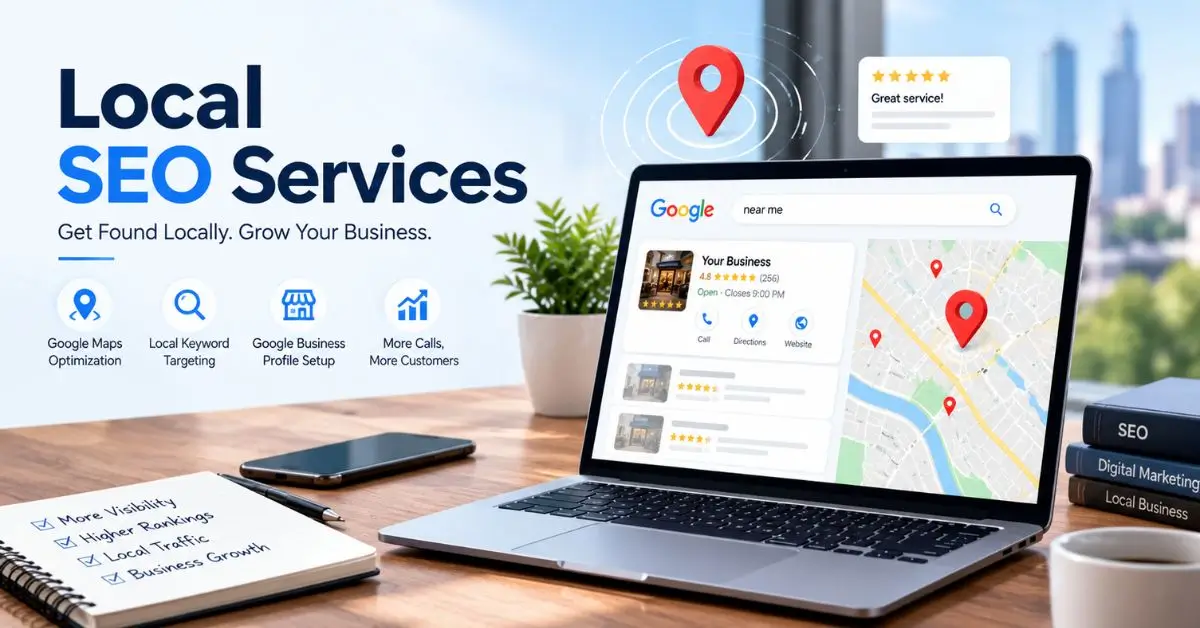
Local SEO services are specialized search optimization strategies designed to help brick-and-mortar businesses and service-area companies appear prominently in local search results, Google Maps listings, and the local map pack. These services include Google Business Profile optimization, local citation building, review management, and geo-targeted on-page improvements that connect your business with nearby customers actively searching for what you offer.
In this guide, you will learn exactly what these services cover, how each component works, what mistakes to avoid, and how to decide whether to handle local search optimization yourself or hire a professional.
Quick Summary
Local SEO services help your business show up when nearby customers search for your products or services on Google. The core work includes optimizing your Google Business Profile, building consistent citations across directories, managing customer reviews, and adding location-specific signals to your website. Done correctly, these efforts drive more phone calls, foot traffic, and qualified leads from your local area.
Why Local Search Optimization Matters More Than Ever
Think about the last time you needed a plumber, a dentist, or a coffee shop. You probably pulled out your phone and typed something like “plumber near me” or “best dentist in Dallas.” You did not scroll past the first three results. You tapped one of the top listings and called.
That is exactly how your potential customers behave too.
Google reports that searches containing “near me” or “in my area” have grown dramatically over the past few years. People want fast, relevant results from businesses they can actually visit or contact today. If your business does not appear in those top local search results, you are handing customers directly to your competitors every single day.
This is where professional local SEO services make a real difference. They focus specifically on the ranking factors that Google uses to determine which businesses appear in the local map pack and the organic results below it.
The Core Components of a Strong Local Strategy
Understanding what goes into local search optimization helps you evaluate providers and set realistic expectations. Here are the main pieces of the puzzle.
1. Google Business Profile Optimization
Your Google Business Profile (formerly known as Google My Business) is the single most important asset for local visibility. It is the listing that appears on Google Maps and in the local map pack at the top of search results.
A fully optimized profile includes:
- Accurate business name, address, and phone number
- Correct primary and secondary business categories
- High-quality photos of your storefront, team, and services
- Detailed business hours including holiday schedules
- A compelling business description with relevant local keywords
- Regular posts about offers, events, and updates
Many business owners claim their profile and then forget about it. That is a missed opportunity. Google rewards active, well-maintained profiles with better visibility in local search results.
2. NAP Consistency and Local Citations
NAP stands for Name, Address, and Phone number. Consistency across the web is critical. If your business is listed as “Joe’s Plumbing” on Yelp but “Joes Plumbing LLC” on Yellow Pages, Google gets confused about which listing is accurate.
Local citations are mentions of your business information on directories, review sites, and industry platforms. Common examples include:
- Yelp
- Apple Maps
- Bing Places
- Better Business Bureau
- Industry-specific directories
Building and cleaning up these citations ensures that search engines trust your business location and contact details. Even small inconsistencies like “St.” versus “Street” can create problems over time.
3. Local Keyword Research and On-Page Signals
Ranking in your city requires more than just a Google Business Profile. Your website itself needs to send clear geographic signals to search engines.
This involves:
- Researching the exact phrases local customers use when searching
- Creating dedicated location pages if you serve multiple cities
- Including your city and neighborhood names in title tags, headings, and meta descriptions
- Embedding a Google Map on your contact page
- Adding local schema markup to your website code
For example, a roofing company in Phoenix should have pages that target phrases like “roof repair in Phoenix AZ” and “emergency roofer near Scottsdale” rather than just generic terms like “roofing services.”
4. Online Review Management
Reviews are a major ranking factor for local search. Google considers both the quantity and quality of your reviews when deciding where to place your business in the map pack.
Effective review management includes:
- Setting up automated systems to request reviews from happy customers
- Responding professionally to every review, both positive and negative
- Monitoring review platforms like Google, Yelp, and Facebook regularly
- Addressing negative feedback quickly and publicly to show you care
A business with 150 recent five-star reviews will almost always outrank a competitor with 12 reviews from three years ago, even if the competitor has a bigger advertising budget.
5. Local Link Building
Backlinks from other websites still matter for local rankings, but the quality and relevance of those links matter more than the quantity.
High-value local links come from:
- Local news websites and online newspapers
- Chamber of Commerce membership pages
- Local charity and event sponsorships
- Neighborhood blogs and community websites
- Local business association directories
One link from your city’s popular news site is worth more than fifty links from random directories that have nothing to do with your area.
How Local Search Differs from Regular SEO
Many business owners assume that general SEO and local search optimization are the same thing. They are not. While they share some overlapping techniques, the ranking factors and goals are quite different.
Regular SEO focuses on ranking your website pages for broad, often national or global keywords. Local search optimization focuses on ranking your business listing and website for geographically specific queries from people who are ready to buy right now.
| Factor | General SEO | Local Search Optimization |
|---|---|---|
| Primary Goal | Rank website pages nationally | Appear in local map pack and nearby results |
| Key Asset | Website content and backlinks | Google Business Profile and citations |
| Target Audience | Broad online audience | Nearby customers ready to visit or call |
| Ranking Signals | Domain authority and content depth | Proximity, reviews, and NAP consistency |
| Competition Level | Often very high | Limited to businesses in your area |
| Time to See Results | 6 to 12 months typically | 2 to 4 months for initial improvements |
The good news is that local competition is usually much smaller than national competition. You are not competing against every business in the country. You are competing against the other businesses in your city or neighborhood.
A Real-World Example
Consider a family-owned dental practice in Austin, Texas. The dentist had a nice website but was getting almost no calls from online searches. Larger dental chains with bigger budgets dominated the top spots on Google Maps.
After implementing a focused local search strategy, here is what changed within four months:
- The Google Business Profile was fully optimized with new photos, updated categories, and weekly posts about services.
- Over 40 inconsistent citations were found and corrected across directories.
- A review generation system was set up that increased their Google reviews from 23 to 87.
- Three new location-specific service pages were added to the website targeting neighborhoods in Austin.
The result was a 60 percent increase in phone calls from local search and a consistent top-three position in the Austin map pack for their main service keywords. The practice did not need a massive budget. They needed a focused, consistent strategy.
Common Mistakes That Hurt Local Rankings
Even well-intentioned business owners make errors that hold back their local visibility. Avoiding these common pitfalls can save you months of wasted effort.
Ignoring your Google Business Profile after setup. Claiming your profile is just the first step. You need to update it regularly with fresh photos, posts, and accurate information to maintain strong rankings.
Using a P.O. Box instead of a real address. Google requires a physical street address for most business categories. Using a P.O. Box can get your listing suspended.
Keyword stuffing your business name. Adding phrases like “Best Plumber in Chicago” to your actual business name violates Google’s guidelines and can result in a listing suspension. Use your real legal business name.
Neglecting negative reviews. Ignoring bad reviews does not make them disappear. Responding calmly and professionally shows potential customers that you take feedback seriously and are willing to fix problems.
Building citations on low-quality directories. Submitting your business to hundreds of spammy, irrelevant directories does not help your rankings. Focus on well-known, trusted platforms that your actual customers use.
DIY vs Hiring a Professional
Should you handle local search optimization yourself or work with an expert? The answer depends on your time, skills, and budget.
If you run a small operation and have a few hours each week to dedicate to learning and implementing changes, you can make meaningful progress on your own. Start with your Google Business Profile, fix your citations, and ask every customer for a review.
However, if you are already stretched thin managing daily operations, hiring a professional who specializes in local SEO services can save you significant time and deliver faster results. An experienced provider already knows which directories matter, how to structure location pages, and how to handle technical issues like duplicate listings and schema markup.
The key is to choose a provider who explains their process clearly, shares regular reports, and focuses on sustainable results rather than quick tricks that violate search engine guidelines.
Conclusion
Getting found by local customers should not feel like a guessing game. When you understand the core components of local search optimization and apply them consistently, your business gains a clear advantage over competitors who neglect their online presence.
Whether you decide to tackle these tasks yourself or partner with a knowledgeable provider, the most important step is to start now. Every month you wait is another month of lost calls, lost foot traffic, and lost revenue going to the businesses that show up first.
If you want a clear, honest assessment of where your business stands in local search and what specific steps would make the biggest difference, feel free to reach out through ahmadwithseo.com for a practical consultation tailored to your market.
Frequently Asked Questions
What exactly do local SEO services include?
Local SEO services typically include Google Business Profile optimization, local citation building, review management, geo-targeted keyword research, on-page location signals, and local link building. The goal is to help your business appear in the local map pack and nearby search results when potential customers look for your products or services.
How long does it take to see results from local search optimization?
Most businesses start seeing noticeable improvements within two to four months of consistent effort. Competitive markets with many established businesses may take longer. Full results with stable top-three map pack positions typically develop over four to six months of ongoing optimization.
How much do local SEO services usually cost?
Pricing varies based on your market size, competition level, and the scope of work. Most reputable providers charge between $500 and $2,000 per month for small to mid-size businesses. Be cautious of extremely cheap offers that promise instant top rankings, as these often use risky tactics that can harm your listings.
Can I do local SEO myself without hiring anyone?
Yes, you can handle basic local search optimization yourself. Start by claiming and optimizing your Google Business Profile, ensuring your NAP information is consistent across major directories, and actively requesting customer reviews. However, advanced tasks like schema markup and competitive local link building often benefit from professional expertise.
What is the most important factor for ranking in the local map pack?
The three biggest factors are relevance, distance, and prominence. Relevance means your profile matches what the user searches for. Distance refers to how close your business is to the searcher. Prominence includes your review count, review quality, and overall online presence. You cannot control distance, but you can strongly influence relevance and prominence.
Do online reviews really affect local search rankings?
Yes, reviews are one of the strongest ranking signals for local search. Google considers both the total number of reviews and the average star rating when determining map pack positions. Businesses with more recent, positive reviews consistently outrank competitors with fewer or older reviews.