

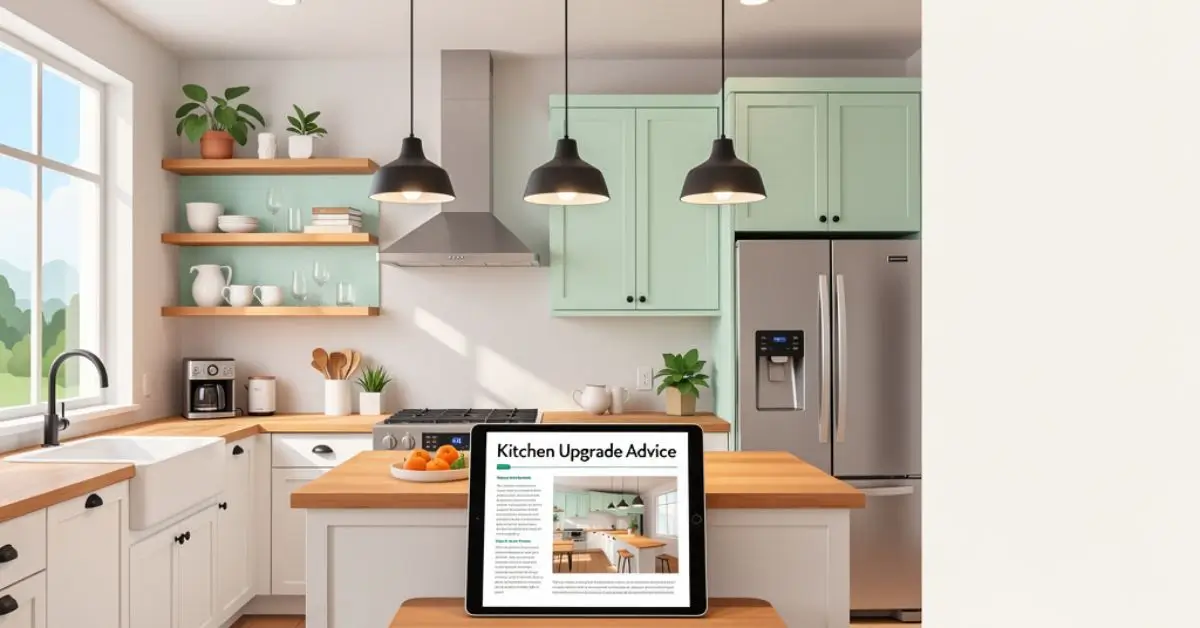
Kitchen Upgrading Advice: Smart Improvements That Pay
The kitchen is the room most homeowners want to improve and the one where poor decisions are most expensive to undo. Unlike a bedroom repaint or a bathroom hardware swap, kitchen upgrades involve cabinetry, countertops, appliances, and plumbing that can quickly push costs into territory that does not recover its value at resale.
This creates a real problem. Homeowners know they want a better kitchen. They are less sure about which specific improvements to make first, what a realistic budget looks like, and which changes actually add lasting value versus which ones satisfy a short-term visual desire without meaningful return.
This guide delivers kitchen upgrading advice mintpalment principles that work. What to prioritize, what the realistic costs are for US homeowners, which improvements consistently deliver the strongest return, and what to avoid spending money on when the budget is limited.
What Is Kitchen Upgrading Advice?
Kitchen upgrading advice mintpalment refers to practical, prioritized guidance on improving a kitchen through strategic changes at different budget levels. Good kitchen upgrading advice starts with the highest-return, lowest-cost improvements and builds toward larger investments only when the foundational changes have been made. It matches spending to the kitchen’s actual problems rather than chasing complete renovation aesthetics, and it provides honest assessment of what each type of change costs and what it realistically delivers in daily function and resale value.
Quick Summary
Smart kitchen upgrading starts with hardware replacement and paint before moving to lighting, then countertops, and only replaces cabinets when they are structurally damaged. This sequence maximizes the visual and functional improvement per dollar spent. This guide covers each stage with specific US cost ranges and honest assessment of what each upgrade actually delivers.
Why Kitchen Upgrade Sequence Matters
The most common kitchen improvement mistake is investing in the wrong change at the wrong time. This happens in two predictable ways.
The first is jumping to expensive changes like countertop replacement before making the lower-cost changes that would have satisfied the desire for improvement more efficiently. A homeowner who spends $4,000 on new countertops but still has 2005 cabinet hardware and inadequate lighting has spent significantly without addressing the most visible dating elements in the room.
The second is replacing structurally sound cabinets when refinishing or painting would have produced equivalent visual results at a fraction of the cost. Full cabinet replacement in a standard US kitchen costs $8,000 to $25,000. Professionally painted cabinets achieve the same visual transformation for $1,500 to $4,000.
Kitchen upgrading advice mintpalment guidance addresses both patterns by establishing a clear priority sequence that produces the most improvement per dollar before escalating to larger investments.
Stage One: High-Impact, Low-Cost Upgrades
These are the kitchen improvements that every homeowner should complete before spending money on anything more significant. They deliver the most visual change per dollar of any kitchen investment.
Hardware Replacement
Cabinet and drawer hardware replacement is the single highest-return kitchen upgrade available. The mechanism is simple. Hardware is the most detailed and visually prominent element in most kitchens. Dated hardware makes every surrounding element look older by association. Current hardware makes an entire kitchen read as more recently updated.
Matte black, brushed nickel, brushed gold, and satin brass in clean, simple profiles are the current finishes that work across virtually all cabinet colors and styles without requiring any other changes. Avoid ornate or highly specific styles that will date as quickly as the hardware being replaced.
Cost for a standard US kitchen: $60 to $400 depending on the number of doors and drawers and the hardware price point selected. Professional installation is straightforward enough for most homeowners to complete as a DIY project in one afternoon.
Fresh Paint
Fresh paint in a warm neutral tone is the second highest-return kitchen upgrade. This applies to kitchen walls above the backsplash, ceiling, and any visible trim or architectural elements.
Warm white, soft sage green, and warm greige are the tones that read as current without being trend-specific. These choices age well as countertops, hardware, and decor change around them.
Materials cost: $40 to $60 per gallon. Professional application for a standard kitchen: $200 to $500. The visual change is immediate and significant. If paint and hardware together do not satisfy the improvement desire, the kitchen likely has a structural problem, dated cabinets or countertops, that warrants a larger investment.
Lighting Update
Single overhead fixtures make kitchens feel flat regardless of every other improvement. Kitchen upgrading advice mintpalment consistently identifies lighting as one of the most under-invested upgrade categories in most US kitchens.
Two specific additions transform kitchen lighting effectively. Under-cabinet LED strips illuminate countertop work surfaces and add warmth at a cost of $100 to $300 installed. A pendant fixture or two over a kitchen island at $150 to $500 adds visual anchoring and a design element that makes kitchens feel finished rather than functional-only.
These two lighting additions together cost $250 to $800 and produce an atmosphere improvement that exceeds what most $2,000 to $3,000 cosmetic upgrades deliver.
Stage Two: Mid-Range Upgrades With Strong Returns
Once the high-impact, low-cost changes are complete, these mid-range investments deliver the next tier of improvement for kitchens where the visual improvement desire remains after Stage One.
Countertop Replacement
Countertops are the most visually significant horizontal surface in any kitchen and one of the most common sources of kitchen dating when they are in poor condition or a style that has aged poorly.
Quartz is the most practical countertop choice for most US kitchens. It is non-porous, requires no sealing, resists staining and scratching better than many natural stone alternatives, and is available in a wide range of finishes from simple white to realistic stone patterns.
A mid-range quartz countertop replacement in a standard US kitchen costs $2,000 to $4,500 installed, depending on linear footage, edge profile selection, and regional labor rates. This investment is justified after Stage One changes have been completed and the desire for improvement remains.
Do not replace countertops as a first step. Hardware replacement, paint, and lighting together cost $400 to $1,300 and often produce enough visual improvement that the $2,000 to $4,500 countertop investment is no longer urgent.
Cabinet Painting or Refacing
When kitchen cabinets are structurally sound but visually dated, painting them is the most cost-effective path to the appearance of a fully renovated kitchen. Professionally painted cabinets cost $1,500 to $4,000 for a standard kitchen. Full cabinet replacement costs $8,000 to $25,000.
The visual result, when painting is done properly, is indistinguishable from new cabinets at a fraction of the cost. The critical qualifier is professional execution. Cabinet painting that skips surface preparation, priming, and multiple finish coats produces a result that chips, yellows, and peels within a year or two. The work done correctly lasts a decade or more.
Cabinet refacing, applying new door and drawer fronts to existing boxes, is an intermediate option at $4,000 to $9,000 that works when the cabinet box structure is sound but the door style or wood species is beyond what paint can address.
Backsplash Installation or Replacement
A new backsplash changes the character of a kitchen meaningfully while covering a relatively small surface area. Subway tile, handmade ceramic, large-format porcelain, and zellige are all options that work well in the current design landscape.
Cost ranges from $500 to $2,500 depending on tile selection, pattern complexity, and kitchen size. This upgrade is appropriate as a Stage Two investment because it layers visual interest on top of the foundational changes rather than serving as a first improvement.
Stage Three: Larger Investments With Specific Justification
These upgrades are only worth pursuing when the Stage One and Stage Two improvements have been completed and the kitchen still has a documented deficiency that requires a larger solution.
Full Cabinet Replacement
Full cabinet replacement is justified only when cabinet boxes are structurally compromised, when damaged repairs are not possible, or when a layout change requiring new cabinet placement is necessary for the kitchen to function appropriately.
Replacing structurally sound cabinets to achieve a different aesthetic when painting would produce an equivalent visual result is one of the most common and expensive unnecessary kitchen expenditures.
Cost range: $8,000 to $25,000 for standard kitchens. Custom cabinetry or large kitchen footprints push costs significantly higher.
Appliance Replacement
Appliances represent the most expensive upgrade category for most kitchens. The most impactful single appliance replacement from a visual perspective is typically the refrigerator, which is the largest visible appliance from the main kitchen sightline.
Matching appliance finishes across the major units, stainless steel, black stainless, or panel-front, creates visual cohesion that makes a kitchen feel considered rather than accumulated.
Replace appliances when they are failing, significantly inefficient, or when they are the last remaining dated element after all other improvements have been completed. Replacing functioning appliances as a first improvement step while hardware, lighting, and countertops remain unchanged does not produce proportionate visual improvement.
Kitchen Upgrading Budget Overview
| Upgrade Type | Low End | Mid Range | Higher Investment |
|---|---|---|---|
| Hardware replacement | $60 | $200 | $400 |
| Paint | $150 | $350 | $600 |
| Under-cabinet lighting | $100 | $200 | $400 |
| Pendant lighting | $150 | $350 | $600 |
| Countertops (quartz) | $2,000 | $3,500 | $5,500+ |
| Cabinet painting | $1,500 | $2,500 | $4,000 |
| Backsplash | $500 | $1,200 | $2,500 |
| Cabinet replacement | $8,000 | $15,000 | $25,000+ |
These ranges reflect typical US market costs. Regional labor rates and material selections significantly affect final project costs.
Common Kitchen Upgrading Mistakes to Avoid
Skipping hardware and paint before countertops. These low-cost changes often satisfy the improvement desire without requiring a $3,000 to $5,000 countertop investment. Always complete Stage One before committing to Stage Two.
Replacing sound cabinets unnecessarily. If cabinet boxes are structurally solid, painting costs $1,500 to $4,000 versus $8,000 to $25,000 for replacement, with equivalent visual results when done professionally.
Choosing trend-specific finishes. Very specific design trends date within five years. Current hardware finishes, countertopmaterials, and tile choices in classic or moderately current rather than highly trend-specific options age significantly better.
Over-improving relative to the neighborhood. Kitchen investments should be proportional to the home’s market value and comparable homes in the area. A $60,000 kitchen in a $350,000 home in a neighborhood where comparable homes sell for $400,000 does not recover its investment at resale.
Conclusion
Kitchen upgrading done well follows a clear sequence that protects spending at every level. Hardware first. Paint second. Lighting third. Countertops and cabinet painting when the lower-cost changes have been completed and the improvement desire remains. Full cabinet replacement only when structurally necessary.
Kitchen upgrading advice mintpalment principles consistently produce better financial outcomes than skipping steps to reach the dramatic result faster. Each stage validates whether the next larger investment is actually needed. Most kitchens reach a visually satisfying outcome at Stage One or Stage Two spending levels, which means the $15,000 to $25,000 that full renovation would have cost stays available for other improvements or financial goals.
Start with hardware. Assess the result. Make the next decision based on what you actually see, not what you imagined the kitchen would need before the first change was made.
Frequently Asked Questions
What kitchen upgrades add the most value?
Hardware replacement, lighting improvements, and cabinet painting or countertop replacement deliver the strongest returns. Minor kitchen remodels consistently recover a high percentage of their cost at resale, often outperforming full renovations in percentage return.
What is the cheapest way to update a kitchen?
Replace hardware, repaint in a warm neutral, and add under-cabinet lighting. These three changes cost under $800 in most US kitchens and produce significant visual improvement without touching cabinets, countertops, or appliances.
Should I paint or replace kitchen cabinets?
Paint them if they are structurally sound. Professional painting costs $1,500 to $4,000 versus $8,000 to $25,000 for full replacement. Replacement is only justified when cabinet boxes are damaged or a layout change is needed.
What is the best countertop material for a kitchen upgrade?
Quartz is the most practical choice. It is non-porous, needs no sealing, and resists staining. Granite suits homeowners who prefer natural stone and are comfortable with annual sealing maintenance.
How much does a kitchen upgrade cost?
Cosmetic upgrades cost $400 to $1,300. A mid-range refresh with countertops and cabinet painting runs $4,000 to $8,000. A full renovation costs $20,000 to $60,000 or more. Most homeowners achieve strong results at the mid-range level.
What kitchen upgrades are worth doing before selling?
Fresh neutral paint, new hardware, improved lighting, and clean countertops support stronger sale prices without large investment. Focus on high-visibility cosmetic changes rather than major renovations before listing.